The PoleOS™ Company



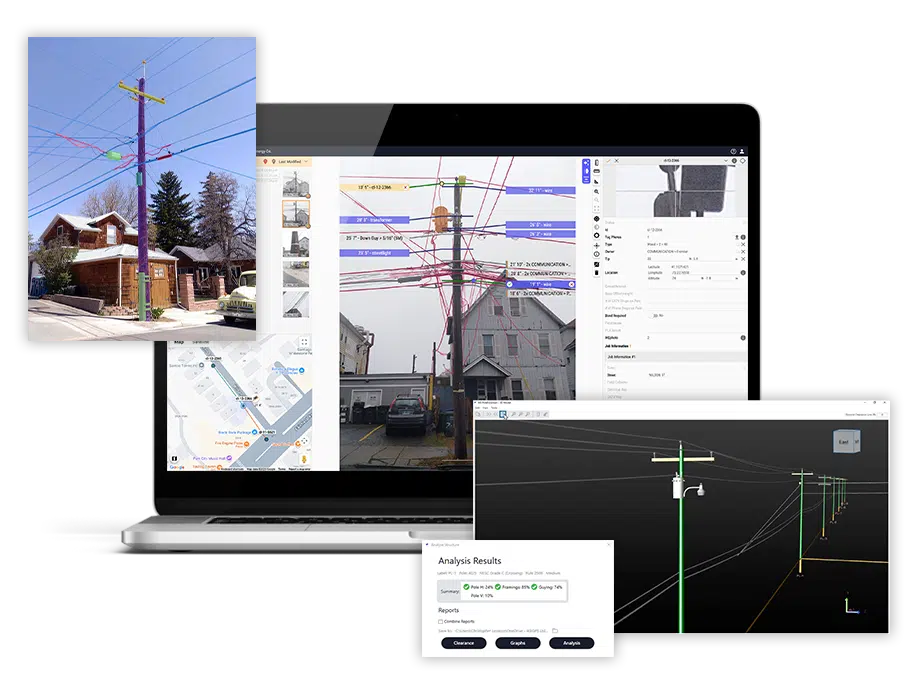


Sharing overhead infrastructure is often the best route for delivering vital power and communication services to customers. The joint use of poles reduces costs, streamlines operations, and improves efficiency. However, it also introduces complexity and inefficiency and presents challenges in coordination and compliance.
IKE’s solutions simplify and accelerate joint-use workflows, helping pole owners and attachers more effectively share infrastructure, maintain compliance, and deliver better service to customers.
Deliver safe, reliable electricity
Avoid overloaded poles and maintain grid reliability and safety with accurate pole data and structural analysis.
-
 Increase pole data quality, standardize data formats, and centralize accessibility
 -
Streamline joint-use workflow and collaborate with third parties
-
Export accurate data to downstream applications
 Increase pole data quality, standardize data formats, and centralize accessibility
  Streamline joint-use workflow and collaborate with third parties
  Export accurate data to downstream applications
Accelerate broadband deployments
Expand to new markets faster with quick and accurate surveys, data analysis, and approvals.
-
Streamline field data collection
-
Quickly conduct pole loading analysis and make-ready engineering
-
Speed up permitting approval time while reducing rejection rates
 Quickly conduct pole loading analysis and make-ready engineering
  Speed up permitting approval time while reducing rejection rates
Deliver projects on time and within budget
Deliver results to utility and communication clients. Streamline workflows. Improve safety and reduce costs while ensuring compliance with regulatory requirements.
-
Control costs by improving asset management and optimizing operations
-
Minimize risks related to coordination, safety, and compliance
-
Collaborate efficiently with all authorized parties of joint-use projects
 Control costs by improving asset management and optimizing operations
  Minimize risks related to coordination, safety, and compliance
  Collaborate efficiently with all authorized parties of joint-use projects
IKE’s joint-use solutions
IKE’s suite of tools for joint-use collaboration is trusted by many of North America’s largest and most respected electric utilities, communications companies, and engineering firms.
IKE Office Pro
Drive the outcomes you need without pole data slowing you down. Centralize your data with secure cloud-based workflows that enable streamlined joint-use projects.
- Create standardized digital pole records
- Remove data silos and share information in near real-time
- Customize workflows to reduce redundancies
- Integrate with downstream applications such as PLA applications, GIS, and asset management systems


IKE Device
Accurately capture data to ensure structural integrity as attachers add equipment to poles.
- Drive down data collection cost per pole with one-person field collection
- Quickly acquire precise measurements and detailed imagery
- Seamlessly upload data, eliminating errors and enabling efficient analysis, reporting, and visualization

IKE PoleForeman
Simplify the joint-use process and ease collaboration with our industry-leading pole loading analysis software.
- Construct accurate as-built models to ensure company-specific and National Electrical Safety Code® (NESC®) compliance
- Propose make-ready models to assess and validate clearance and strength requirements
- Identify clearances and separation between conductors or groundlines

Joint-Use Ticket Automation from IKE Insight
Take the legwork out of National Joint Utilities Notification System (NJUNS) ticketing with intelligent automation, saving time and eliminating manual data entry.
- Structure and normalize NJUNS ticket data
- Tackle common ticketing bottlenecks, such as violation reports from safety audits or broadband build-outs
- Improve collaboration between pole owners and attachers on joint-use programs
Why Toth & Associates chose IKE
The multidisciplinary engineering firm achieved the scale needed to take on and successfully deliver large (50,000+) pole projects by making the IKE Device integral to their fielding process and adopting IKE Office Pro to bring the field data together.
Read Customer StoryTyler Barnes
Project Manager, Toth & Associates
Scale operations and gain efficiency and safety
We needed a single device that removed four or five devices from our fielders’ hands and the software to bring all of our field data together.
Related Resources

National engineering firm tackles mountain of NJUNS tickets with Joint-Use Ticket Automation from IKE Insight
IKE Insight enabled the firm to create thousands of tickets in three weeks.
Read Now
National Electrical Safety Code® (NESC®) Rules for Joint-Use Construction
About this class This class provides an overview of NESC rules that apply to joint-use construction (power and communication), focusing on practical examples and applications...
Read Now
A guide for broadband network expansion: Overcoming bottlenecks in the pole attachment process
The expansion of broadband infrastructure is vital for modern communication and economic development, creating opportunities in both urban and rural areas. As the need for...
Read NowIKE is trusted by
5 of the 10
largest communications companies in the U.S.


IKE is trusted by
8 of the 10
largest investor-owned electric utilities in North America


FAQs
What does joint-use mean?
Joint-use refers to when two or more utilities share a pole. It typically involves power and telecommunications providers, but can also include municipalities, medical facilities, and other third-party entities.

What role does pole loading analysis play in the joint-use process?
Accurate pole loading analysis is paramount for ensuring the safety and structural integrity of utility poles. Pole loading analysis determines if a pole can safely support the weight and tension of new attachments, considering existing attachments, environmental factors (wind, ice), and the pole’s material and condition. Overloaded poles are a serious liability that can lead to outages and hazards.
Are there National Electrical Safety Code (NESC) rules that apply to joint-use construction?
Yes. The NESC establishes baseline requirements for pole attachments, covering aspects like clearances, grounding, and structural integrity. The Code requirements are intended to be integrated into design and construction standards and operating practices.