The PoleOS™ Company



Understanding the NESC rules for streetlights in the Communication Worker Safety Zone
In an earlier blog post, we explored the Communication Worker Safety Zone – its definition according to the National Electrical Safety Code (NESC) and the nuances of measuring clearances on joint-use utility poles.
We also learned that streetlight components are one of the exceptions for equipment that can be installed within it, specifically:
- Span wires or brackets for luminaires (streetlights) or traffic signals (Rule 238C)
- Drip loops to supply power to streetlights (Rule 238D)
It’s important to understand how to apply these guidelines in real-life situations.
The Rule of Four
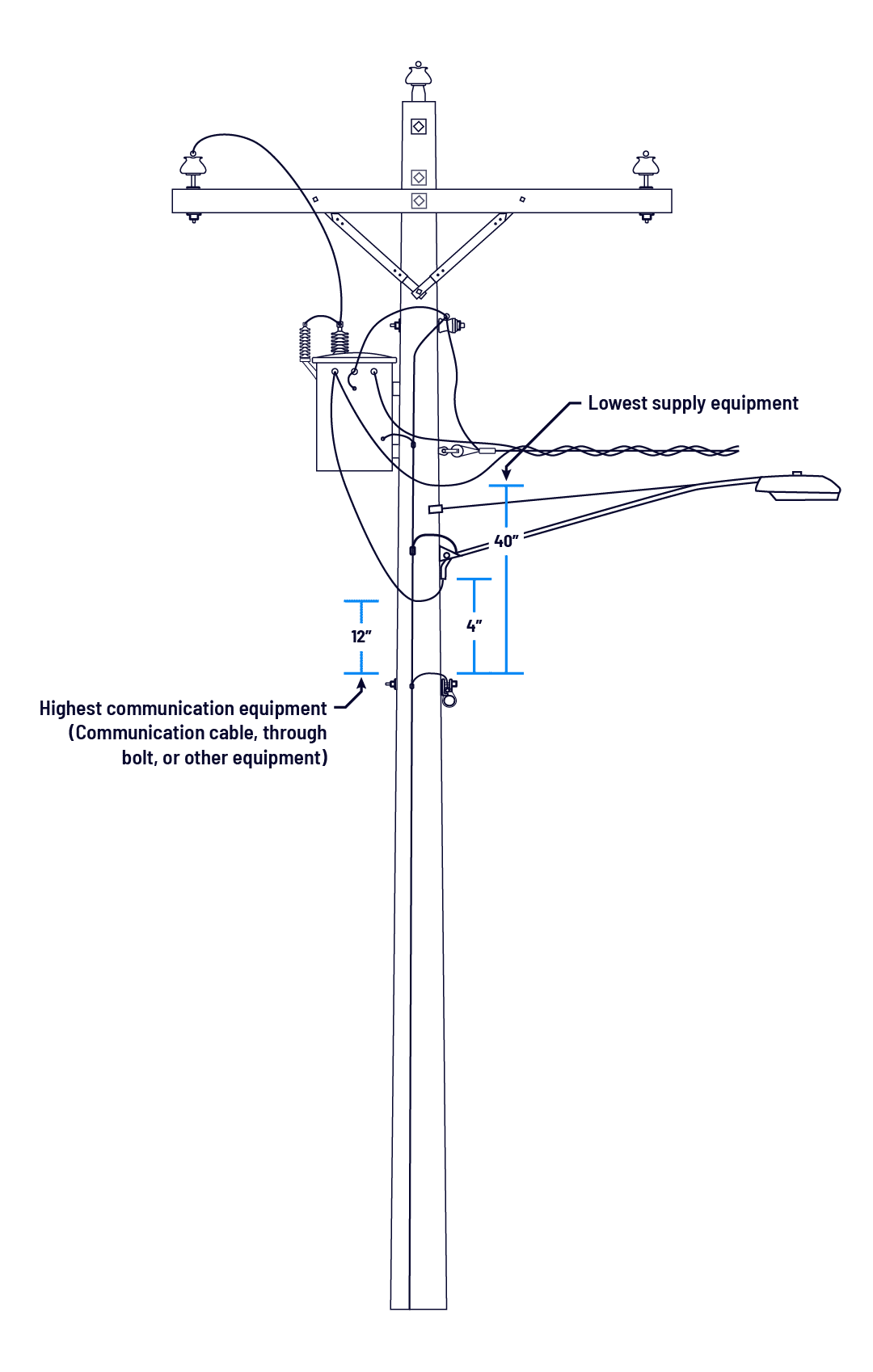
The regulations in NESC Rule 238, establish what some industry professionals call “the rule of four”—streetlight clearances are either 4 inches or 40 inches, depending on specific conditions.
Grounded vs. ungrounded streetlights
A significant change occurred in the 2017 version of the NESC that fundamentally altered streetlight installation practices. Prior to 2017, ungrounded streetlights could be installed in the Communication Worker Safety Zone with a 20-inch clearance. However, the 2017 Code revision increased this requirement to 40 inches, effectively prohibiting ungrounded streetlights in the safety zone.
For grounded streetlights, the minimum clearance remains at 4 inches, provided there is a visible bond from the pole ground to the streetlight fixture. This grounding requirement ensures that any electrical fault will be safely conducted to ground rather than creating a hazard for communication workers.
Drip loop considerations
The Code allows drip loops serving streetlights to come as close as 12 inches to communication equipment. However, if the streetlight itself is positioned closer than 12 inches (down to the 4-inch minimum for grounded lights), an exception permits the drip loop to be positioned as close as 3 inches— only if it’s covered with “suitable non-metallic covering.”
This “suitable covering” requirement uses deliberately vague language, leaving room for interpretation. Electrical tape would not qualify as suitable covering due to weather degradation concerns. Instead, utilities typically use specialized plastic or rubber coverings designed to protect communication workers from exposed wiring that may have deteriorated insulation.
Additional equipment restrictions
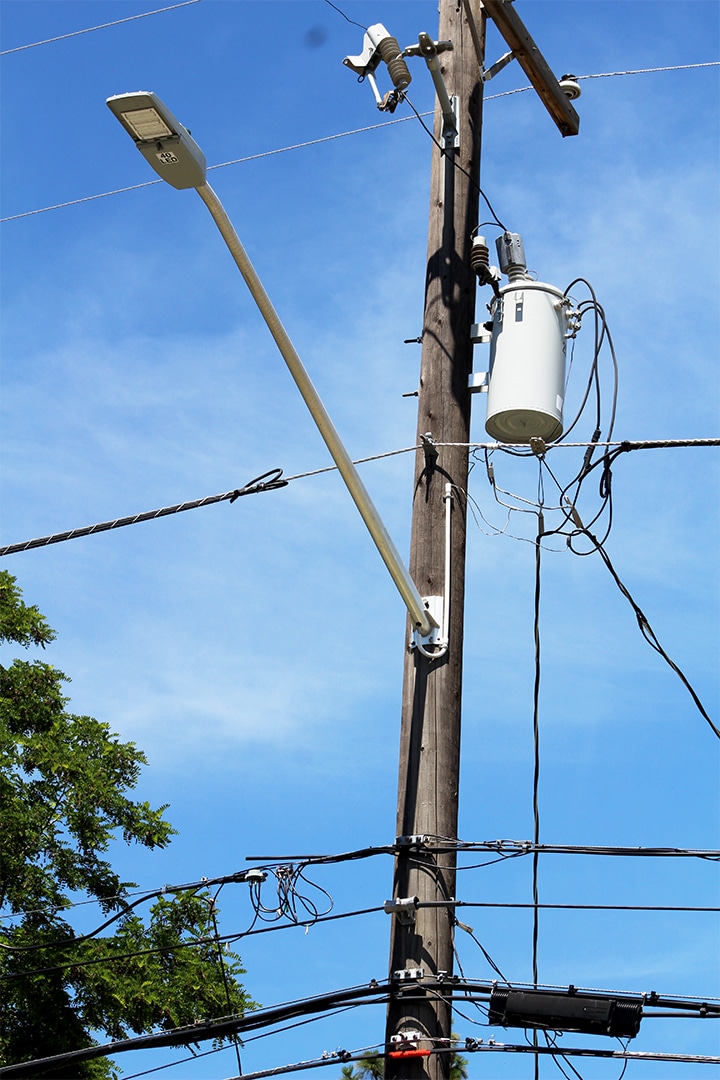
A common question in the field involves mounting additional equipment—such as traffic cameras, wireless meters, or radio equipment—on streetlight brackets. Despite the streetlight exception, these additional devices must maintain the full 40-inch clearance from communication equipment. The streetlight exception does not extend to auxiliary equipment, even if it’s powered through the streetlight’s electrical connection.
In our NESC training classes, we break down the complexities of the Code, such as the Communication Worker Safety Zone, and demonstrate how to apply it to real-life scenarios. This knowledge helps you in your daily work and is critical for ensuring safety and compliance. We offer a range of class options, from 90-minute overviews to in-depth 2-day classes that can be delivered onsite or online.
Know the Code. Stay safe.
Learn more about NESC and OSHA training classes with IKE
Grant Glaus is a registered professional electrical engineer with 25 years of experience in electric utility engineering, including line design, planning studies, joint use, and teaching NESC®, OSHA, and distribution line design classes. He has served on IEEE NESC committees since 2006 and is currently a member of the NESC Main Committee and Subcommittee 5 Overhead Lines–Strength and Loading. Before joining IKE, Grant had 15 years of experience supervising the engineering department at Columbia Rural Electric Association.

The latest from the IKE Wire
Video Chat: Challenges and Opportunities for Power Delivery Leaders (Part 2)
Overview Energy industry expert and author, Peter Kelly-Detwiler, Dennis Elsenbeck, h...
Read MoreIntroducing PolePilot™: Intelligent automation for utility pole analysis
Analyzing distribution pole imagery is traditionally a manual, time-consuming process...
Read MoreHow to streamline pole attachment processes to meet the FCC’s new rules
The Federal Communications Commission (FCC) recently issued new rules to speed up the...
Read MoreSubscribe to the IKE Wire
Get the latest insights on data acquisition and structural analysis from the ikeGPS experts.